

My Beloved, late wife Chicchan and I loved Bhutan and we talked often about taking a group of like minded souls there – and sharing our joy with them. She left this plane too soon to filfil that wish and I now offer this tour in her honour.
It encompasses many of the unique places we visited, based on her meticulous planning, particularly the Ura Yakchoe festival, a high altitude valley, community gathering that dates back to the first century AD. It is a lived tradition that we will be privileged to participate in. A very special experience.
Below is a version of an article I wrote which appeared in Living Now magazine. September, 2008
All Photos © Raym Richards
BHUTAN – A SPIRITUAL ODYSSEY
Imagine an unspoiled country nestled into the foothills of the Himalayas with sensational scenery, soaked in soft high altitude sunlight and with a vibrant spiritual energy that goes back centuries. A place where billboards, traffic lights and tobacco are not allowed. A place where the people have not been spoiled by inconsiderate Western tourists looking for cheap fun. A place full of ancient castles, temples and monasteries which have been in uninterrupted daily use since the 8th century. A place where a smile goes a long way, as locals focus on gross national happiness rather than gross national product.
A rarity in Asia, Bhutan is also a place where you will not be hassled on the streets by people desperate to sell you anything to generate an income.
The Bhutanese are a proud and independent people with their own welfare state and free education system in which all Bhutanese children learn English, which they are eager to practice. The Bhutanese do not readily barter or demean themselves by hassling tourists.
I was in a dusty arts and crafts shop in Bhumtang, in the spiritual heartland of Bhutan, where I witnessed a loud tourist attempting to barter with the shop owner. In a restrained manner the smiling shopkeeper advised, “Madam, this is not India, I do not bargain, these goods are sold at a fair price, take them or leave them”. She was flabbergasted – I was impressed.
I recently spent ten days in Bhutan with my wife Chicchan. It had been a long cherished dream of ours to visit the area, but frankly we had been put off by the cost. To visit Bhutan you must spend a minimum of $200 US per person, per day, in advance. I thought it was overpriced.
Once I had arrived I quickly changed my mind.
On tour we enjoyed three good square meals a day, a transport driver, a very knowledgeable English speaking guide and new three star hotel accommodation, with excellent facilities, every night. Great value for money and a totally hassle free, easy going holiday.
As soon as you arrive in this high altitude paradise your breath is taken away by the scenery and the architecture. The view from the airport runway is stunning and the airport terminal building itself is a work of art. It is also that far above sea level that once you start climbing hills to get to remote monasteries you may find there just isn’t enough oxygen to power your muscles in the manner to which you have become accustomed. So the all the views become breathtaking – literally.
Bhutan has an interesting history, it fought and won a war with neighboring Tibet and successfully repelled the English invaders from India. It is predominantly Buddhist and people practice their faith daily, through prayers, meditations and chants. They also celebrate significant religious events with colorful annual festivals, several of which we were lucky enough to witness.
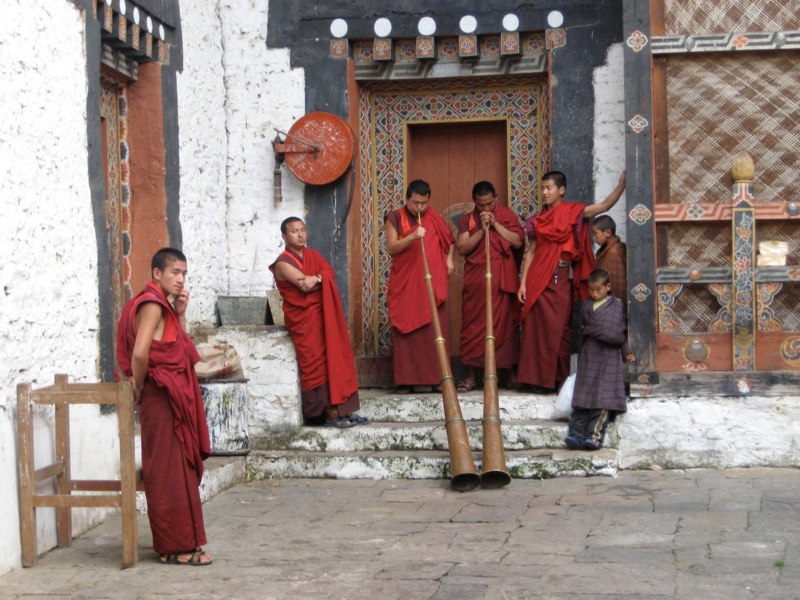
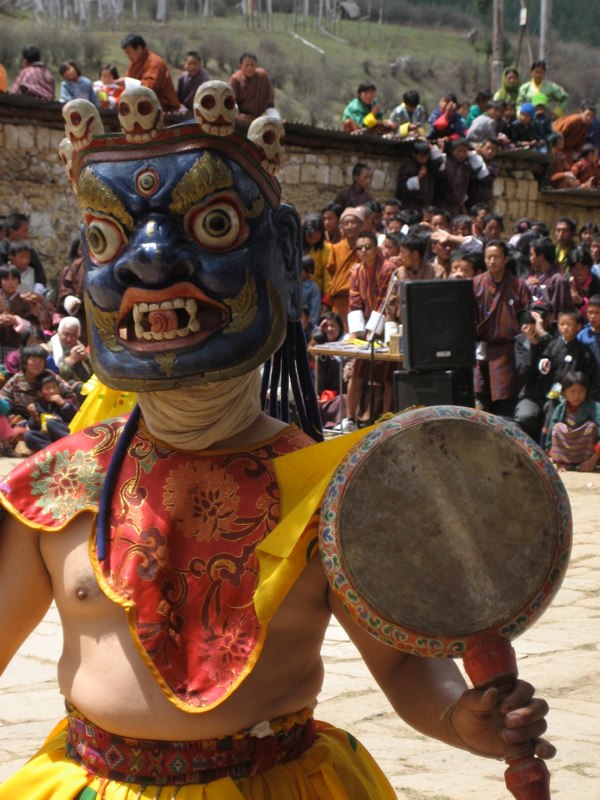
We travelled to remote high altitude valleys where local lamas and monks, dressed ancient costumes and masks, performed arcane dances and rituals, in the packed courtyards of crumbling monasteries. The festivals are well attended by locals and are an integral part of a vibrant living Buddhist culture. It was great to see the contained focus of the dancers as they circled, stamping out mandalas in time to the drums and trumpets of the nearby monks, some of whom played their trumpets out of the 2nd or 3rd floor windows of the monastery overlooking the square in which the festival was held. The dancers where fantastic, as where their costumes and wild hats and masks.
All cultures seem to have a jester, a Punchinello, the Commedia dell’Arte clown who like the English Punch has no respect for anything or anyone. In this case the red masked ‘jesters” carried large wooden phalluses which they had no end of fun brandishing in front of visitors and locals alike.
One thing you will see a lot of in Bhutan are forests and Phallus’s. Bhutan is still densely forested and tree cutting is strictly regulated. Phalluses are everywhere, they often adorn ordinary houses most of which have several murals on the outer walls. They are also hung from the four corners of any new building. Our guide advised us that they are there to ward off the “evil eye”. They repel any negative thoughts that passers by might be sending to the house or the family inside it. The theory is that the phallus embarrasses people into taking their negative thoughts back.
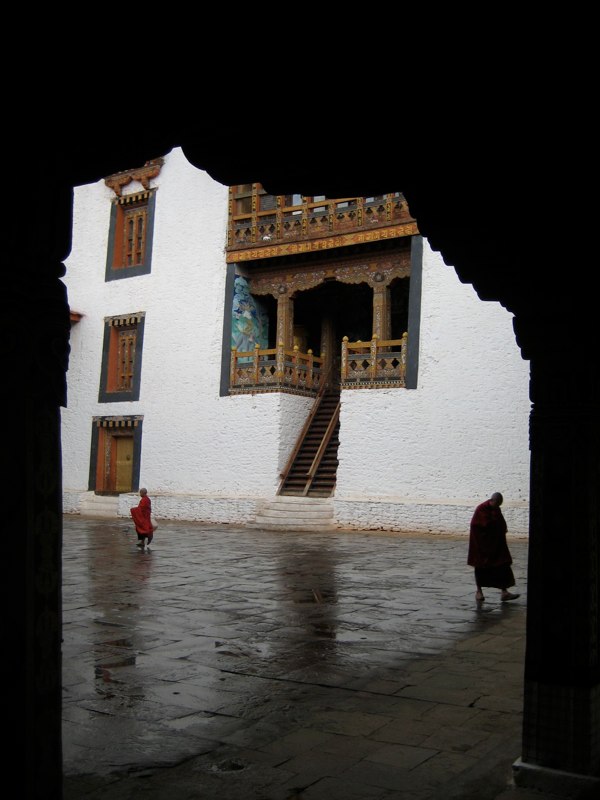
Bhutan has an abundance of 8th – 16th Century “Dzongs” or forts. These are now occupied symbolically by fifty percent government administration and fifty percent religious institution and their architecture is stunning. We visited Dzongs built of huge solid timber beams with floorboards much thicker than standard Australian joists, Made of rammed earth, stone or mud brick, many of the Dzongs do not have any nails in the timber structure at all. Quite a feat of engineering and a sign of a highly developed culture.
Many Dzongs are being renovated by talented local craftsmen and being brought back to their original standard of building. Many are still in in their original state and still look and feel fantastic. We were not allowed to take photographs inside the temples, which have exquisite murals and carvings close to their most hallowed parts. We saw enormous three story high gold Buddhas, rooms filled with 1000 statues of Buddha and an endless variety of finely painted murals.
And in some monasteries we were not just the only tourists, we were the only visitors there!
We visited the breathtakingly beautiful high altitude Tiger’s Nest and Cheri monasteries, well worth the strenuous and steep climb to get there. Huge creaking old wooden doors that opened into to dark inner sanctums were unlocked for us by creaking old caretakers, happy to share their secrets with us.
We found ourselves invited into the holiest section of one monastery built around a cave in which a great Lama had taught. We sat with monks in a hazy incense filled room with light from the Himalayas streaming through the high small window. This shaft of light illuminated ancient treasures and red robed monks as they chanted and played trumpets, all part of their three day Puja. It was a sensational experience and one which I will never forget.
We sat with the monks for what seemed like hours as the chanting washed over us and the trumpets blared around us, then in a lull in the chanting the monks brought us hot tea and popcorn, their only sustenance during the days of chanting. I felt honored. They could see that we really appreciated being included in their ceremony, the only people in the whole monastery who were not Bhutanese monks.
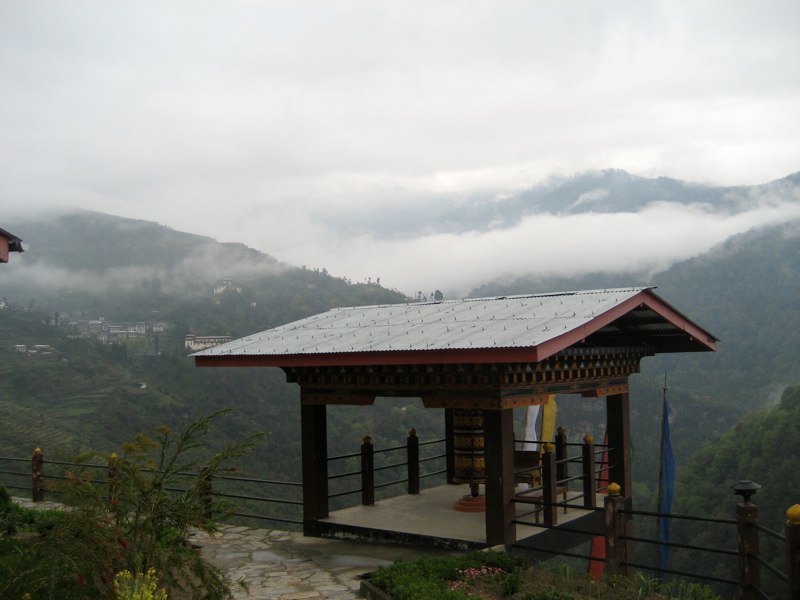
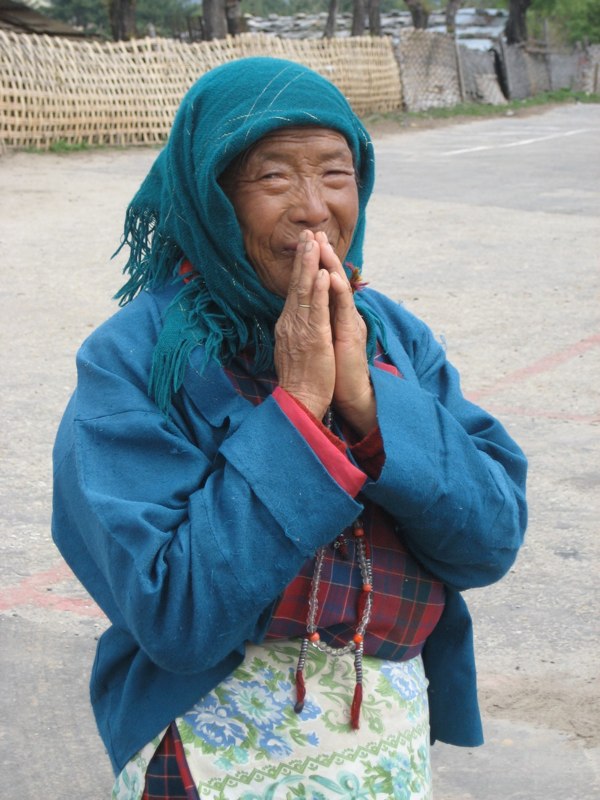
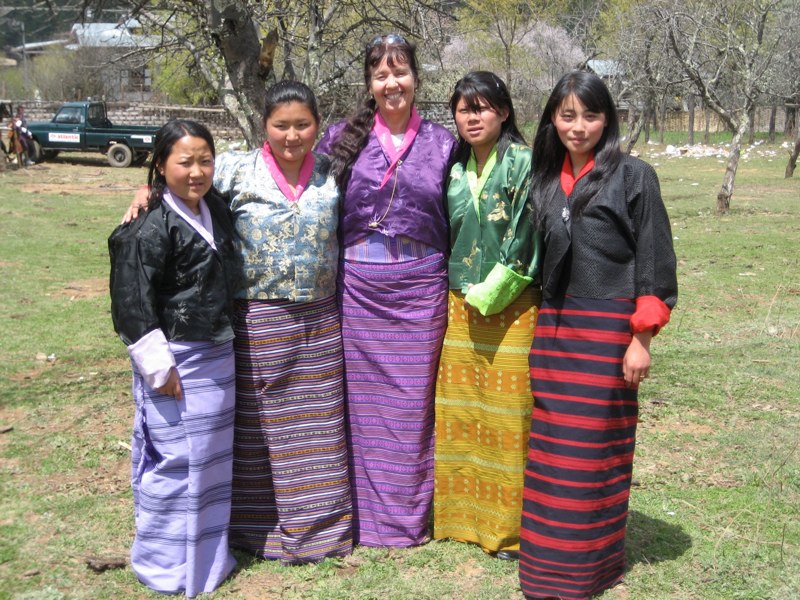
We will treasure our memories of Bhutan, traveling with our driver, quietly chanting mantras for our protection as we passed through sensational scenery. I loved the water powered prayer wheels built by the local community to endlessly share blessings with those who passed, what a generous gesture. And the prayer flags, hundreds of them, placed wherever the wind would catch and distribute their prayers, a constant reminder of the faith practiced by the Bhutanese. Always met with smiles and kind words, I found the Bhutanese to be a warm, gentle and a attractive people – their round symmetrical faces making for exceptionally pretty young women and alert fine featured men.
If you are considering a visit to Bhutan now is the time to go. I hope this new democracy is wise enough to preserve a great asset, the unique and unspoiled energy that makes Bhutan so appealing to the genuine traveller and spiritual seeker.
Raym Richards June 2008